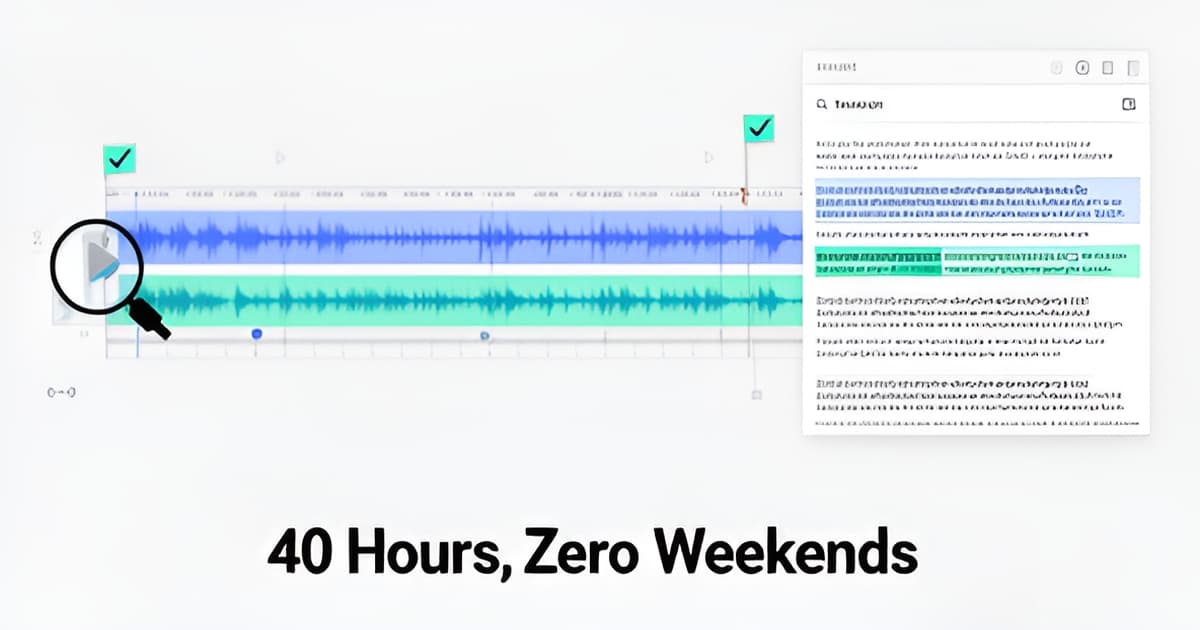
If you're defending a case right now, the discovery dump probably arrived the way they always do: a link to a folder, a stack of files with names like X13qrt9__x3455, and a due date. Forty hours of bodycam. Two interrogation videos. A 911 call. Eleven jail calls. A police report scanned so many times it barely qualifies as a PDF. The old workflow hasn't changed in twenty years. You open the video, hit play, and hope the important moment happens while you're watching. You scrub. You re-watch. You keep a legal pad of timestamps. Then you do it again for the next file, and the next, until preliminary hearing prep eats a week you didn't have. There's a better way to structure this work, and it doesn't require trusting an AI to think for you. It requires making every claim traceable to the exact second it came from. Here's the workflow.
Key points
- Modern discovery dumps routinely include 40+ hours of bodycam and interrogation footage alongside PDFs, 911 audio, and jail calls, making manual line-by-line review time-prohibitive.
- Word-level timestamped transcripts with speaker diarization turn unsearchable video into text you can query, but only if every claim traces back to the exact second of footage.
- Automated inconsistency signals (report vs. bodycam, statement vs. call audio) surface candidate impeachment material before you think to ask for it.
- Frame-accurate redaction with immutable originals and an audit trail keeps discovery turnover defensible, and nothing AI-suggested is ever auto-applied.
- Published pricing matters: Evidence Copilot's PD tier runs $750/attorney/yr against JusticeText's roughly $1,200, with no feature tiers and a 14-day money-back guarantee.
Before you can analyze anything, the media has to become text you can search. That means transcription with speaker diarization and word-level timestamps for the video and audio, and OCR for the scanned PDFs and photo evidence that arrived with no text layer at all. This is where most DIY setups break down. Local Whisper will transcribe a file, but it won't reliably separate the officer from the suspect in a chaotic bodycam clip, and it won't handle specialized legal terms. NotebookLM will summarize, but a summary without a citation is worthless when you need to impeach a witness at a hearing. You need the transcript to point at the exact moment, not paraphrase it. Evidence Copilot handles ingestion by web upload or email attachment up to 2 GB per file, and each case gets its own inbound email address, so attachments can flow in the same way discovery actually arrives. Every transcript segment carries word-level timestamps, and renaming a speaker once propagates across every segment they appear in. That last detail saves more time than it sounds like it should.
The most valuable part of a structured review isn't the search. It's the signals. When every new file is automatically compared against the evidence already in the case, candidate inconsistencies surface as unreviewed items before you've thought to look for them. The report says consent to search was given at 9:14. The bodycam shows the conversation didn't reach the car until 9:31. The witness statement says one thing; the jail call audio suggests another. Those gaps are where suppression motions and cross-exam questions live. In practice, this changes the order of operations. Instead of reading the police report and then grinding through footage hoping to catch a discrepancy, you start from a list of candidate conflicts, each with both sides quoted and cited, and you verify them yourself. The system flags. You judge. That division of labor is the only ethical way to use these tools, and it's why every AI output in the workspace is marked as AI-generated and pending human review. The product never draws legal conclusions.
For a motion to suppress, the playbooks do the assembly work. The Suppression Motion Prep sweep covers consent, search scope, stop duration, K-9 deployment, and Miranda in one pass, drafting a motion outline with both sides' quotes and citations attached. The Miranda Timeline builds a chronological custodial-interrogation timeline from the actual footage and reports. What you get back is a starting point, not finished work product. Every suggested question in a cross-exam draft is tied to a quoted source, and no credibility conclusions are drawn. You still have to decide whether the discrepancy matters and how to use it. But you're starting from a verified quote at a timestamp instead of from memory of a video you watched three days ago.
Discovery turnover usually means redaction, and this is an area where shortcuts create real risk. In Evidence Copilot, video redaction is frame-accurate: you drag a rectangle and choose black or blur. Audio redaction works by selecting the exact spoken words, and that span gets muted. Image and PDF redaction work the same way, with bounding boxes preserved from OCR. Two design choices matter here. First, every redaction produces a new derived file; the originals are never modified, and every action is audited. Second, AI-suggested regions (bystander faces, minors, license plates, PII screens) arrive as suggestion cards marked as needing review. Nothing is ever auto-applied. If you've ever had to explain to a judge why a face got blurred that shouldn't have been, you understand why that gate exists.
When an event was captured from multiple angles, bodycam, dashcam, and interview-room footage can be linked to a single master clock. Synced playback with an interleaved transcript turns a confusing multi-angle mess into one coherent record. Auto-sync proposals are computed from word-timing correlation and come with their match evidence attached, something like 31 word matches within a 0.2-second spread. The proposals are never applied automatically; you review and approve them. For cross-referencing what was said in the interview room against what was happening on the street at the same moment, this is the difference between an afternoon and a week.
One integration is worth flagging for the skeptics. Evidence Copilot exposes a read-only MCP server, so you can query your cases from Claude Desktop, ChatGPT, Claude Code, or Cursor through a standard OAuth sign-in with no tokens to manage. The functions are limited to listing cases, listing and searching evidence, reading transcript windows, and getting citations. Access is org-scoped, revocable, and fully audited. No other defense-side platform currently offers an MCP integration at all. If your research workflow already lives in Claude or Cursor, your evidence can live there too, without copying files or pasting unverified summaries.
Pricing is published, and there's no feature-tier maze. Solo runs $39/user/month with 15 media-processing hours included. Firm is $99/user/month with 60 hours. The Public Defender Office plan is $750/attorney/year with 100 hours, which undercuts JusticeText's roughly $1,200/attorney/yr by about 38 percent. Overage is metered and hard-capped at 3x included hours, so a surprise intake dump can't produce a surprise invoice. New accounts verify email and start on a 7-day full-access Firm-level trial with no card required. If a trial lapses, processing pauses but your cases and files stay accessible. Every paid plan carries a 14-day money-back guarantee: email [email protected] within 14 days of the first charge for a full refund.
None of this replaces the judgment you bring to a case. A flagged inconsistency still needs a lawyer to decide what it means, and a drafted motion outline still needs a lawyer to write the argument. What changes is the starting point. Instead of forty hours of playback and a legal pad, you start from a grounded brief, a list of cited candidate conflicts, and transcripts you can actually search, with every claim one click away from the exact second it came from. That's a defensible workflow, and it's the one this platform was built around. If you want to see it on your own discovery, book a 20-minute walkthrough at evidencecopilot.com/book or start on the Solo plan at evidencecopilot.com/signup.