You've been there. The DA's office sends a link, you download it, and you're staring at 40 gigabytes of bodycam, two interrogation videos, a stack of scanned police reports, and nine jail calls. The files are named things like X13qrt9__x3455. Nobody gave you an index. The preliminary hearing is in three weeks. This is the actual job of a criminal defender in 2026, and most of us were never taught a system for it. Here's a workflow that works, whether you use dedicated software or a spreadsheet and a lot of coffee.
Key points
- Discovery volume is the core problem: a single felony case can hand you dozens of hours of bodycam, jail calls, and scanned PDFs with filenames like X13qrt9__x3455.
- Transcription with speaker diarization and word-level timestamps turns video review into text review, which is faster and easier to cite accurately.
- Comparing the police report against the bodycam transcript is where impeachment material lives: distance, timing, and quoted statements that don't match.
- Every AI output should carry a citation to the exact source moment and be marked for human review; the attorney, not the software, makes the call.
- Grounded evidence workspaces like Evidence Copilot publish pricing (Solo $39/user/mo, Firm $99/user/mo, PD Office $750/attorney/yr) with no sales wall.
Before you press play on a single video, build your evidence inventory. List every file, its type, its length or page count, and what it purports to show. This sounds tedious. It saves you later, because the inventory becomes the backbone of your exhibit list, your suppression motion, and your cross-examination outlines. If you're working in a workspace built for this, like Evidence Copilot, the inventory is generated for you on upload, and each case gets an inbound email address so paralegals can forward discovery attachments straight into the case instead of managing a download folder. If you're doing it manually, a shared spreadsheet works fine. The point is that you can't analyze what you haven't catalogued.
Watching 40 hours of footage to find the 12 minutes that matter is how defenders burn out. Transcription flips the problem: you read the footage first, then watch only the moments that matter. The key details are speaker diarization (who said what) and word-level timestamps (when they said it). Without diarization, you get a wall of text you can't attribute to the officer versus your client. Without timestamps, you can't cite the moment in a motion or pull the clip for a hearing. Tools like Evidence Copilot run Deepgram Nova transcription with both, and let you rename speakers once so the fix propagates through the whole transcript. The free DIY route, local Whisper plus NotebookLM, gets you text but no diarization QC, no citations, and no audit trail, and it tends to fall apart once a case has more than a few files.
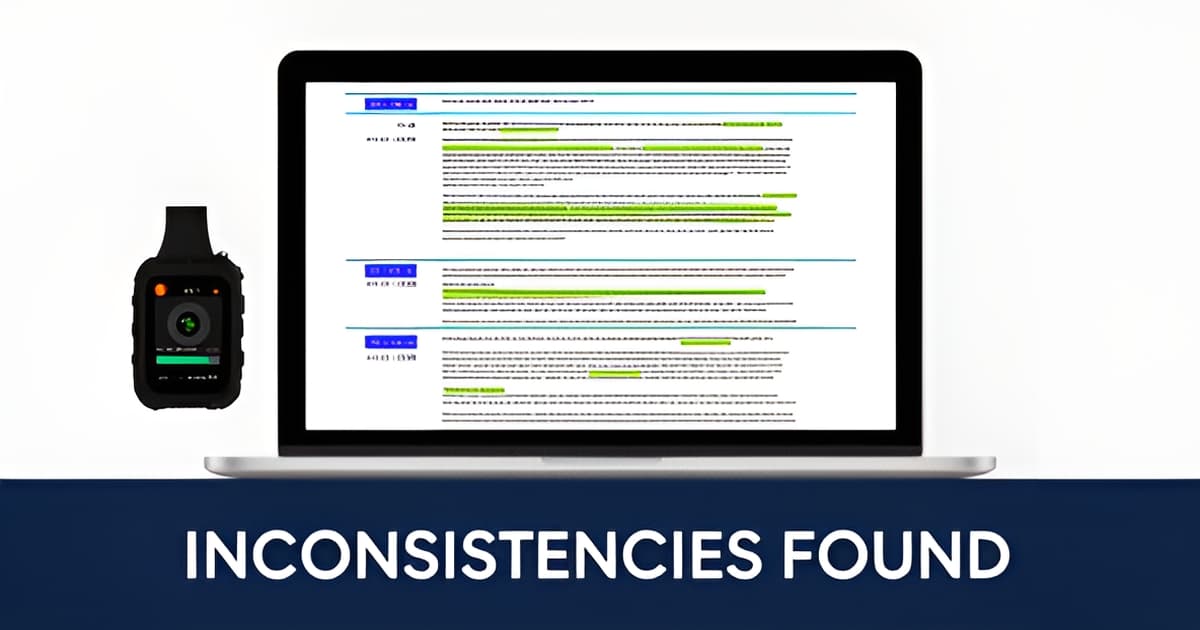
This is the step that pays. Police reports are written after the fact, from memory and from notes, and they routinely diverge from what the camera recorded. Read the report side by side with the bodycam transcript and hunt for three things. First, statements: does the quoted language in the report match what was actually said, word for word? Second, sequence: does the report put events in an order the footage contradicts? Third, scope: does the report describe a consensual encounter that the video shows as a detention? A report that says the defendant 'consented to a search' paired with footage showing a handcuffed client saying nothing at all is the beginning of a motion to suppress. Evidence Copilot automates a first pass at this: every newly ingested file is compared against earlier evidence in the case, and candidate inconsistencies between the report and the bodycam, or between a statement and a jail call, surface as review signals before you've asked a single question. The signals are unreviewed until you look at them. The software doesn't conclude anything. It points, you judge.
Once you've flagged the inconsistencies, put everything on one clock. When did the encounter start? When did the officer say the suspect was free to leave? When was the arrest? When did the interrogation begin, and when were the Miranda warnings read, if ever? A custodial interrogation timeline is often the whole ballgame on a suppression motion. If the case has multiple cameras, bodycam plus dashcam plus the interview room, sync them. Doing this by hand with a video editor is miserable; Evidence Copilot's multi-camera sync links the sources to a master clock and proposes the alignment using word-timing correlation, reporting the match evidence (say, 31 word matches with a ±0.2 second spread) so you can accept or reject it. Nothing syncs automatically. You verify.
An inconsistency you can't cite is worthless in court. Every question you ask on cross needs a source: the report page, the transcript second, the clip. Evidence Copilot's cross-exam drafts work this way, generating suggested questions from a review signal with both sides quoted and each question tied to its source, saved as attorney-review notes with no credibility conclusions. The Suppression Motion Prep playbook runs the same sweep across consent, search scope, stop duration, K-9 use, and Miranda, and drafts a motion outline with both sides quoted and cited. You still write the motion. You still decide what to file. But the grunt work of assembling the quoted record is done, and every quote clicks through to the exact second of video or page of the PDF it came from.
Discovery turnover and witness preparation often require sharing evidence that contains bystanders, minors, victim identifying information, or license plates. Redaction is where DIY workflows collapse: frame-accurate video redaction by hand takes hours, and a missed face is an ethics problem. Evidence Copilot handles manual frame-accurate video redaction (drag a rectangle, black or blur), audio redaction at the word level (pick the exact words, that span gets muted), and image and PDF redaction. Its AI can suggest regions like minor faces and PII screens, but every suggestion lands as a card marked 'AI-suggested, needs review' and nothing is ever auto-applied. Every redaction is a new derived file. The original stays untouched, and every action is audited, which matters when the prosecution asks how the produced version was created.
If you're comparing tools, the honest landscape looks like this. JusticeText runs around $1,200 per attorney per year and gets transcription-quality complaints. Reduct does video transcription and clip extraction but misses specialized legal terms. CoCounsel from Thomson Reuters, at roughly $400 per user per month, is research and memo AI with no evidence-media review at all. Axon Evidence is the prosecutor-side platform defenders are forced to use, with a slow player and no analysis. Evidence Copilot's published pricing: Solo at $39/user/month with 15 media-processing hours, Firm at $99/user/month with 60 hours, and a public-defender office tier at $750/attorney/year with 100 hours, which undercuts JusticeText by roughly 38 percent. Overage is metered and hard-capped at 3x the included hours so a runaway discovery dump can't blow up your bill. Every plan includes the full workspace; there are no feature tiers. There's a 7-day full-access trial with no credit card, and a 14-day money-back guarantee on every paid plan.
The discovery dump isn't going to get smaller, and nobody is going to hand you a better index. The defenders who handle volume well are the ones who stop watching and start reading, put every piece of evidence on one timeline, and treat the police report as a claim to be checked against the footage rather than a summary to be accepted. Whether you build that system yourself or use a grounded workspace, keep the non-negotiables in place: every AI output marked for human review, every claim traceable to the exact source moment, and the legal judgment staying with you. If you want to see the workflow end to end, book a 20-minute walkthrough at evidencecopilot.com/book or start a trial at evidencecopilot.com/signup.