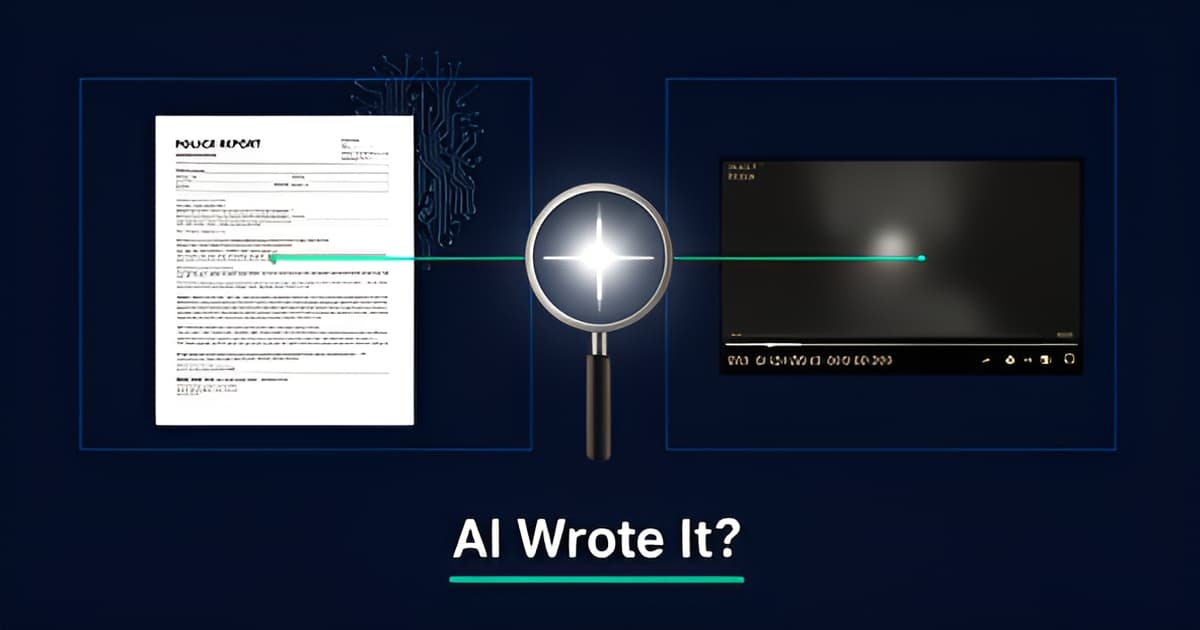
Somewhere between the bodycam audio and the police report sitting in your discovery, there may now be a machine. Tools like Axon Draft One and Truleo Field Notes generate draft narratives directly from bodycam recordings, and departments are adopting them fast. The pitch is workload relief, and for understaffed agencies drowning in digital evidence, it's an easy sell. The U.S. surveillance and law-enforcement AI market sits at roughly $1.32 billion today, with projections pushing past $34.72 billion by 2035. What got less attention in the recent Police1 roundup on AI in policing was a quiet admission buried in the middle of it: most current AI report-writing tools don't let defense attorneys compare the AI-generated draft against the final submitted report. The industry says it's 'actively working to address' that gap. You shouldn't wait for them.
Key points
- Axon Draft One cut report-writing time 67% in Fort Collins, but Anchorage PD dropped it after seeing no real savings, so AI-drafted reports vary wildly in quality.
- A Police1 industry article concedes that most AI report-writing tools don't let defense attorneys compare the AI-generated draft against the final submitted report.
- The documented failure mode with police AI is officers treating machine output as verified fact, which is exactly the gap a report-vs-bodycam comparison is built to catch.
- At least 15 states now require corroborating evidence before an arrest based only on a facial-recognition match, and New Jersey's Supreme Court has ordered disclosure of how facial recognition was used.
- 68% of investigators say digital-evidence review time is stalling their cases; defenders face the same discovery mountain from the other side.
The tools in the field are concrete and named. Axon Draft One builds narratives from bodycam audio. Truleo Field Notes pairs transcripts with draft reports. CopEntry, PoliceNarratives.ai, and Caseify all convert structured notes or call data into narrative form. Officers spend up to 40% of their working hours on reports, so the incentive is obvious. Results, though, are all over the map. Fort Collins, Colorado reported a 67% reduction in report-writing time with Draft One. Anchorage PD tested the same tool and abandoned it after finding no meaningful savings. Same software, opposite outcomes. Which means the report in front of you might be polished AI output, a rough AI draft an officer barely skimmed, or something in between. You have no way to know from the document itself, and nobody is required to tell you.
The Police1 article identifies a consistent pattern across police AI deployments, and it's worth reading carefully as a defender. The recurring failure isn't the technology misfiring. It's officers treating AI output as verified fact rather than an investigative lead. Facial recognition is the starkest example: some systems misidentify Asian and Black individuals at rates up to 100 times higher than white men, and documented wrongful arrests have followed. That's why at least 15 states now require corroborating evidence before an arrest based solely on a facial-recognition match, with seven more considering similar laws. The New Jersey Supreme Court recently ruled that prosecutors must disclose how facial recognition was used in an investigation. The legal system is converging on one principle: machine output isn't evidence until a human verifies it. You already apply that standard to their AI. Apply it to the report too.
Here's the workflow. Start by transcribing everything with speaker diarization and word-level timestamps, so every statement in the footage has an address. Then run the police report against the footage systematically. Does the report's account of the stop match the first ten seconds of bodycam? Does the reported consent to search match what the defendant actually said, in his words, at the timestamp? Does the 'agitated and aggressive' description survive contact with the video? Does the Miranda recitation in the narrative line up with the interrogation-room recording? These are the classic report-vs-bodycam impeachment points defenders have always hunted for. What's changed is that AI-assisted drafting makes the hunt faster and, given the Anchorage result, sometimes more productive. A machine-generated narrative can inherit errors from noisy audio, dropped words, or diarization mistakes, and an officer signing off under time pressure may not catch them. In Evidence Copilot, this comparison is the core loop: upload the discovery dump, and every new file gets compared against earlier evidence in the case. Candidate inconsistencies between the report and the bodycam, or between a statement and a jail call, surface as unreviewed review signals before you've asked a single question. Each one carries citations that jump to the exact second of video or page of the PDF, so you verify it yourself before it becomes a cross-exam line.
Once you've verified an inconsistency, the drafting work is mechanical and shouldn't eat your evening. From a confirmed review signal, you can generate suggested cross-exam questions with both sides quoted, every question tied to its source, saved as an attorney-review notes. The tool doesn't draw credibility conclusions; that's your call as counsel. For search-and-seizure issues, the Suppression Motion Prep playbook sweeps consent, search scope, stop duration, K-9, and Miranda facts and drafts a motion outline with both sides quoted and cited. The Miranda Timeline playbook builds a chronological custodial-interrogation timeline from the interrogation footage. If you're preparing for a preliminary hearing on a short clock, the one-click case brief gives you an evidence inventory, key moments, and open follow-ups, all grounded in the actual files. The point of all of it is the same: the machine surfaces candidates, you make the judgments, and every output is marked AI-generated and pending human review.
The New Jersey disclosure ruling points toward a practice worth adopting regardless of jurisdiction: ask, in writing, whether AI tools were used in generating any report in discovery, and whether draft versions exist. Facial recognition corroboration statutes in 15-plus states give you a statutory hook in the identification context. The same logic extends to AI-drafted narratives. If a report was machine-generated from bodycam audio and then edited, the edits are potentially exculpatory and the draft is potentially discoverable. You won't win every one of these motions, but you can't win the ones you never file. In the meantime, the comparison workflow above doesn't depend on getting the draft. The footage is already in your discovery, and the submitted report is already in your discovery. The gap between them is sitting there waiting.
One more number from the Police1 piece: 68% of investigators report that digital-evidence review time is stalling case progress and compounding heavy caseloads. The prosecution's bottleneck is your bottleneck too, just mirrored. You're getting the same discovery mountain with a fraction of the staffing. That's the honest case for defense-side tooling. Evidence Copilot publishes its pricing with no sales wall: Solo at $39/user/month with 15 media-processing hours, Firm at $99/user/month with 60 hours, and a PD Office tier at $750/attorney/year with 100 hours, with overage metered and hard-capped at 3x included hours so a runaway discovery dump can't overbill you. Every plan includes the full workspace. There's a 7-day full-access trial without a card and a 14-day money-back guarantee. For reference, JusticeText runs about $1,200/attorney/year and has drawn transcription-quality complaints, and Axon Evidence remains the prosecutor-side platform you're forced to use, with a slow player and no analysis.
Police AI isn't going away, and the report in your next case may already be machine-assisted. The industry's own coverage admits defenders can't currently see the AI draft behind the submitted narrative. Until that changes, the strongest position is to do the comparison yourself: timestamped transcripts of the actual footage, checked line by line against the report, with every inconsistency verified by a human before it reaches a courtroom. That's not a technology bet. It's just careful defense work, done faster.